
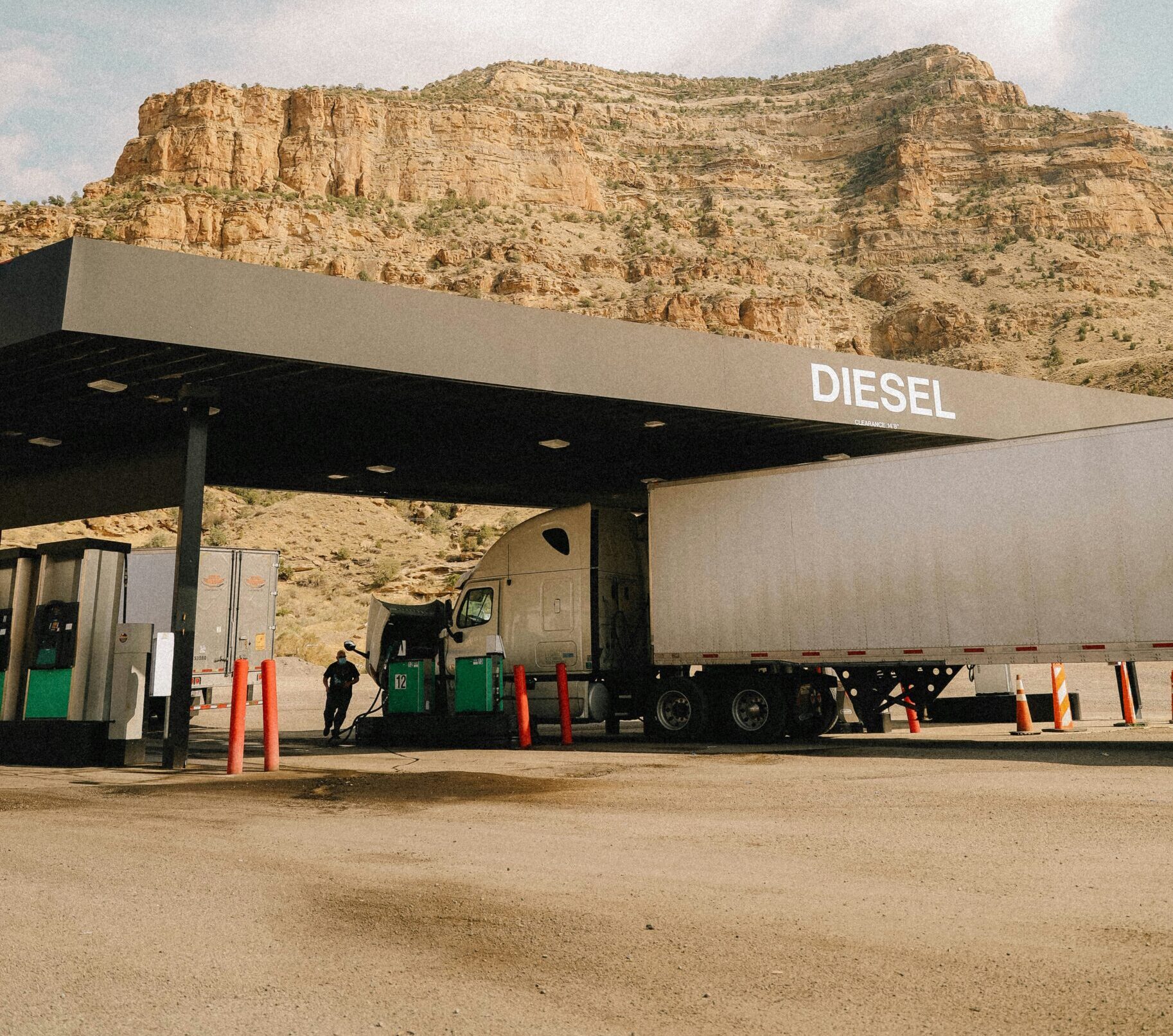
Semi truck fuel cost is the single largest variable expense in an owner operator’s business — and one of the most misunderstood. Gross revenue numbers get posted everywhere. Real fuel costs rarely do. This guide breaks down exactly what owner operators spend on diesel in 2026, what drives those costs up or down, and how to calculate your exact number before you accept a single load.
How Much Does It Cost to Fuel a Semi Truck?
The average semi truck gets between 6 and 7 miles per gallon under normal highway conditions with a standard load. At the national average diesel price of approximately $3.80 per gallon in 2026, that works out to:
- At 6.0 MPG: $0.63 per mile in fuel costs
- At 6.5 MPG: $0.58 per mile in fuel costs
- At 7.0 MPG: $0.54 per mile in fuel costs
On a 500 mile load that difference adds up fast. A truck getting 6.0 MPG spends $317 on fuel. A truck getting 7.0 MPG spends $271 on the same run. That $46 difference across 100 loads per year is $4,600 — real money that comes directly out of your net income.
Use the Fuel Cost Calculator to calculate your exact semi truck fuel cost for any trip based on your MPG and current diesel prices in your region.
Average Diesel Prices by Region in 2026
Diesel prices vary significantly by region. The West Coast consistently runs the highest prices in the country — California averages $1.00 to $1.50 per gallon more than the national average. The Gulf Coast and Southeast run the lowest, with Texas and Louisiana typically among the cheapest states for diesel.
| Region | Average Diesel Price |
|---|---|
| U.S. National Average | $3.80/gal |
| East Coast | $4.10/gal |
| Midwest | $3.72/gal |
| Gulf Coast | $3.55/gal |
| Rocky Mountain | $3.78/gal |
| West Coast | $4.40/gal |
These prices update weekly from EIA data. Strategic fueling — buying diesel in lower-cost states and avoiding fueling in high-cost regions when possible — can save a long-haul driver thousands of dollars per year.
Semi Truck Fuel Cost Per Mile at Different Diesel Prices
Your fuel cost per mile changes every time diesel prices move. Here is what owner operators are paying at various price points with a typical 6.5 MPG truck:
| Diesel Price | Fuel Cost Per Mile | Cost on 500 Mi Load |
|---|---|---|
| $3.40/gal | $0.52/mi | $262 |
| $3.60/gal | $0.55/mi | $277 |
| $3.80/gal | $0.58/mi | $292 |
| $4.00/gal | $0.62/mi | $308 |
| $4.20/gal | $0.65/mi | $323 |
| $4.50/gal | $0.69/mi | $346 |
| $5.00/gal | $0.77/mi | $385 |
The difference between fueling at $3.40 and $5.00 per gallon on a single 500 mile load is $123. At 100 loads per year that is $12,300 in additional fuel expense — more than enough to cover a full month of truck payments.
Annual Semi Truck Fuel Cost
At 100,000 miles per year — a common benchmark for full-time owner operators — here is what annual fuel costs look like:
| MPG | Diesel at $3.80/gal | Diesel at $4.20/gal | Diesel at $4.60/gal |
|---|---|---|---|
| 5.5 MPG | $69,091 | $76,364 | $83,636 |
| 6.0 MPG | $63,333 | $70,000 | $76,667 |
| 6.5 MPG | $58,462 | $64,615 | $70,769 |
| 7.0 MPG | $54,286 | $60,000 | $65,714 |
| 7.5 MPG | $50,667 | $56,000 | $61,333 |
Fuel is typically 25 to 35 percent of total operating expenses for a semi truck owner operator. At $58,000 per year in fuel costs on a $180,000 gross revenue operation, fuel represents 32 percent of gross — before any other expenses are paid.
What Affects Semi Truck Fuel Economy
MPG is not fixed. It varies based on how you operate your truck, the loads you haul, and the condition of your equipment. Understanding what moves the needle gives you real control over your fuel costs.
Speed. This is the biggest factor. A truck running 65 mph gets significantly better fuel economy than one running 70 mph. The difference between 65 and 75 mph can reduce fuel economy by 15 to 20 percent. At 100,000 miles per year that is thousands of dollars in additional fuel cost for the extra speed.
Load weight. Heavier loads require more power and burn more fuel. A truck hauling a 44,000 pound load will get lower MPG than the same truck running 28,000 pounds. Factor this in when you see loads that pay well per mile but run heavy — the actual fuel cost will be higher than your baseline.
Terrain. Mountain driving burns significantly more fuel than flat highway. If your lanes regularly cross the Rockies, Appalachians, or other significant elevation changes, adjust your baseline MPG down when calculating fuel costs for those runs.
Engine condition. A properly maintained engine runs more efficiently. Air filter restrictions, injector issues, and turbo wear all reduce fuel economy. Regular preventive maintenance pays dividends in fuel savings over time.
Tire pressure. Under-inflated tires increase rolling resistance and reduce fuel economy. Checking tire pressure regularly is one of the simplest and most impactful fuel-saving habits an owner operator can build.
Aerodynamics. Roof fairings, side skirts, and other aerodynamic aids can meaningfully improve highway fuel economy. Older trucks without these features run at a fuel efficiency disadvantage compared to newer aerodynamic models.
Idle time. Excessive idling burns fuel without generating miles. Modern APUs (auxiliary power units) allow owner operators to maintain cab comfort without running the main engine, significantly reducing idle fuel consumption on long layovers.
How to Calculate Your Exact Fuel Cost
Your fuel cost per mile is calculated with a simple formula:
Fuel cost per mile = Diesel price per gallon ÷ Miles per gallon
At $3.80 per gallon and 6.5 MPG: $3.80 ÷ 6.5 = $0.585 per mile
For a specific load you also need to account for deadhead miles — the empty miles you drive to reach the pickup. Those miles burn fuel without generating revenue and need to be included in your true fuel cost calculation.
Total fuel cost for a load = (Loaded miles + Deadhead miles) ÷ MPG × Diesel price
Use the Fuel Cost Calculator to run this calculation automatically with live regional diesel prices. It also shows you a best case and worst case range based on price variance so you know your exposure before you commit to a load.
Fuel Cost as a Percentage of Revenue
Knowing your fuel cost per mile only tells part of the story. What matters for load decisions is fuel as a percentage of the rate you are being offered.
At $2.20 per mile and $0.58 per mile in fuel costs, fuel represents 26 percent of your gross revenue on that load. If your total cost per mile including all fixed and variable expenses is $1.65, you have $0.55 per mile left — a 25 percent profit margin.
Tighten the rate to $1.90 per mile on the same load and fuel now represents 31 percent of revenue with a much thinner margin. This is why fuel cost is not just a logistics number — it is a business decision input on every single load.
Use the Load Profitability Calculator to see fuel cost, total costs, and net profit on any load before you say yes to a broker.
Tips to Reduce Your Semi Truck Fuel Cost
Fuel strategically. Use apps like GasBuddy or the live regional prices in the Fuel Cost Calculator to identify where diesel is cheapest along your route. Buying in Texas versus California on a cross-country run can save $100 or more per fill.
Maintain steady highway speeds. Cruise control on flat highway keeps your speed consistent and eliminates the fuel-wasting acceleration and deceleration cycles of manual speed management.
Plan fuel stops in advance. Running low on fuel forces you to stop wherever you are regardless of price. Knowing where you will fuel before you leave the terminal lets you buy in low-cost locations.
Keep up with preventive maintenance. Fresh air filters, properly functioning injectors, and correct tire pressure all contribute to better fuel economy. The cost of a filter is trivial compared to the fuel savings over 100,000 miles.
Consider an APU. If you sleep in your truck regularly, an auxiliary power unit pays for itself in reduced idle fuel consumption within a year or two for most operators.
Make Sure Your Numbers Are Dialed In
- Fuel Cost Calculator — Calculate your exact semi truck fuel cost for any trip with live EIA diesel prices by region.
- Cost Per Mile Calculator — See your total cost per mile including fuel, fixed expenses, and variable costs.
- Load Profitability Calculator — Calculate net profit on any load after fuel, deadhead, and all costs before you accept.
- IFTA Quarterly Tax Calculator — Calculate your quarterly IFTA fuel tax across all states with 2026 diesel rates.
Disclaimer: Fuel prices and MPG figures in this post are based on industry averages and EIA data for 2026. Actual fuel costs vary based on your specific equipment, routes, load weights, and driving habits. Always calculate your exact costs before making load decisions.